
(summer 2022)
I would like to begin by acknowledging that the land on which I conducted my research is the traditional and unceded territory of the Kanien’keha:ka (Mohawk), a place which has long served as a site of meeting and exchange amongst nations. I am grateful for the opportunity to learn more about Two-Spirit identities as I undertake an ongoing journey towards decolonising my research, listening to the custodians of this land, and paying respect to Indigenous peoples. I hope that this exhibition brings some visibility to more recent projects focussing on 2SLGBTQ+ Indigenous identities in family settings, particularly through a presentation of the 2021 Report on Indigenous LGBTQ+ and Two-Spirit Needs, commissioned by the LGBT Family Coalition in partnership with Women and Gender Equality Canada.
This project seeks to explore how perspectives on queer family-raising practices have changed in Québec from the mid-twentieth century, through to the present day. My aim here is to provide a consultative resource – presented as an interactive timeline format – for AGQ visitors, fellow researchers, and those interested in the sociological intersections between advancements in queer liberation on the one hand, and the changing role played by the institution of the family in the province on the other. Its mission is to not only turn to history to see what obstacles have been overcome by members of the community, but to trace patterns of continued inequality which still afflict 2SLGBTQ+ family members, their parents, and particularly those members wishing to start families of their own.
In summer 2022, I had the pleasure of exploring the vast array of materials catalogued by the AGQ, which began to weave together this tapestry of how life has changed for 2SLGBTQ+ peoples in Québec over the course of the last century, particularly in terms of paternity, filiality, and family-making. In this chronology, I have made efforts to use as wide a variety of media and draw on as many lived experiences as possible. To help follow the remit of the AGQ’s mission to preserve the mémoires de nos communautés, I examine testimonies ranging from archival newspaper clippings of opinion pieces, legal documents, and photographs to – more recently – music, children’s books, and resources from online community outreach organisations. Where possible, I have provided a digital scan of the document at hand, along with a reference to its location in the AGQ (or elsewhere) for those wishing to know more.
My scope for this exhibition spans seven decades, beginning in the mid 1960s at the height of the Révolution tranquille. In the first of four sections, covering 1966—1979, I examine the role played by local, national, and international newspapers as interlocutors in the debate over whether members of the LGBTQ+ community had the right to not only cohabit, but to be recognised by law and – more pressingly – begin families of their own. Indeed, most of the pieces I uncovered spun the web of moral panic that gays supposedly orchestrated against the institution of the family; to allow them equal access to a still-sacrosanct unit would be “ridicule” (1966), a means of “corrupting minors” (1966), and, more bluntly put, “a farce” (1978). As we will see, however, there were some positive outlooks buried alongside these fears; fears largely based upon the unfounded belief that, even after the passing of the C-150 bill which decriminalised homosexuality on a federal level, homosexuals posed a threat to the Québécois family unit and, therefore, to provincial and national values.
In the second section – covering the period 1979—1989 – I explore records of more organised responses to the oppression faced by queer parents in Québec, as well as testimonies of the lived experiences of queer and questioning youth in the province at the time. In particular, I examine (among others) the records of the early days of the “Parents of Gays in Canada” Montréal contingent (1980); the beginnings of the Association des pères gais de Montréal (1982); and a 1988-study of the Jeunesse Lambda Youth project, which revealed that among queer youth, relationships with one’s parents (particularly, the mother) and family ranked among the most significant preoccupations for them. This section of the timeline also includes testimonies from Marie Mayrand’s ground-breaking memoire Le combat de la mère d’un transsexuel (1986), as well as parents’ experiences of the murder of their HIV-positive child (1989), to paint a picture of how members of the community were beginning to rally together and rise up against systematic oppression lingering from before the Révolution tranquille.
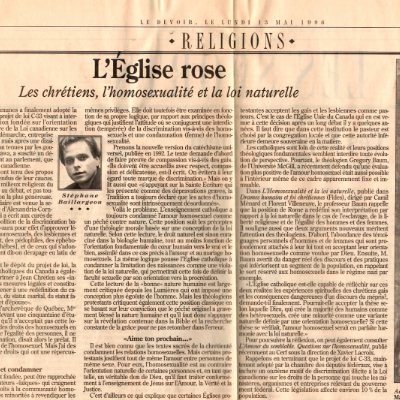
Thirdly, I turn to the period 1989—2000 to look at queer parenthood in times of crisis, particularly following the ongoing epidemiological trauma of the 1980s. Although loi C-33 – which added specifically homosexual-orientated civil liberties and conjoint status to the Canadian Charter of Rights and Freedoms – was enacted in 1996, it remained the case that social attitudes towards queer parenthood still had some way to go. The “Death-Mask” rally which marked World AIDS Day in 1990 along rue Ste Catherine, and which represented the 93 women who had – until then – died of AIDS in Québec, accompanied news that ‘one-third of Québec women infected with HIV have passed the virus to their children’: AIDS was no longer the “gay” disease it was viewed as in the 1980s, and was now entering the public, heterosexist consciousness and, ergo, families. It was a decade of progress and difficulty: Stéphane Baillargeon’s 1996-article L’Église rose responded to the enactment of loi C-33 by highlighting some ongoing reticence swirling in the Catholic Church, citing Archbishop of Québec Maurice Couture as saying: “In the name of equality, there must exist no discrimination […] But, I have some reservations about bestowing certain rights which have familial or social repercussions”. This section closes with a reflection on Michel Dorais’ Mort ou fif (2000) published at the turn of the millennium: the first French-language publication on the alarming rate of suicide among Québec’s gay-identified youth, which openly discussed family relations in a queer context.
The fourth and final part of this timeline finds itself navigating the 2000s through to the present-day. Here, I turn my attention to literature aimed both at parents of queer children – in the form of guidebooks (Vivre avec l’homosexualité de son enfant, 2007; Familles LGBT+: Le guide, 2015), reports (“Sondage d’opinion auprès des Canadiens: L’homoparentalité”, 2014), and online strands of community organisations (REZO-Santé, 2013) – and to tomorrow’s generation of adults, particularly through the medium of children’s books which celebrate non-normative family units in Québec and beyond (Ida-Jane & Olivier: Secrets de famille (2014); Le dernier qui sort éteint la lumière (2017); Les Papas de Violette (2017)). Moreover, I conclude with an important reflection on a recently-published report on “Indigenous LGBTQ+ and Two-Spirit Needs” (2021), which offers recommendations for the most appropriate interventions to help 2SLGBTQ+ parents, families, and children, based on extended conversations and respect-based focus groups with Indigenous communities themselves. All of these carefully orchestrated approaches to broader parts of the community suggest a more forward-looking future for queer family units in Québec. But, as with all things in the battle for equality and recognition, time will surely tell if this is the case.
Ultimately, I hope that this timeline can serve as a working document which offers an overview of how things have changed in Québec for 2SLGBTQ+ families, and for all of those who form part of these communities.
Content note: There will be discussion of suicide at the end of Section 3 (in Michel Dorais’ Mort ou fif)
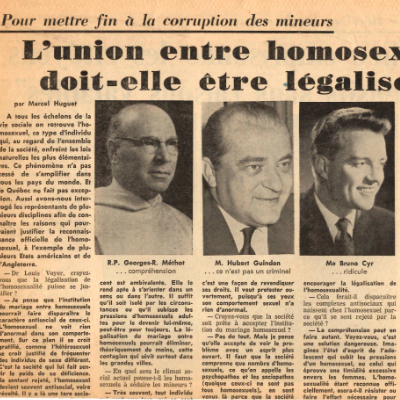
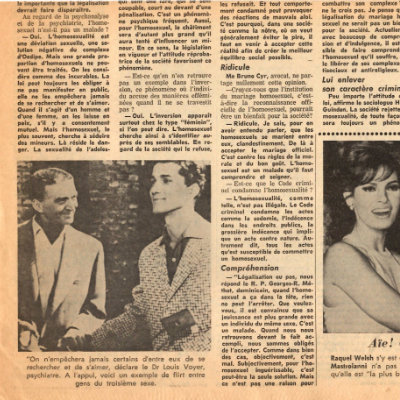
This timeline begins in 1966, with a Photo Journal headline which reads scarily close to moral panics still found in some of today’s anti-queer narratives. “Pour mettre fin à la corruption des mineurs” [“To put a stop to the corruption of minors”], it seems to conclude – before discussion has had chance to begin – that marriage and civil unions between gay men “ne serait pas un bienfait pour la société” [“would be of no benefit to society”]. Indeed, of the four contributors largely opposed to the idea, Dr Louis Voyer appears as most quasi-in favour of the proposal, though not for the joy and equality it would bring to same-sex couples; rather, it would placate the gay community, “faire disparaître le caractère antisocial de ceux-ci” [“alleviate their antisocial character”] and, more absurdly, prevent them from praying on juveniles (“Mais l’homosexual, le plus souvent, cherche à séduire les mineurs”). Bruno Cyr, then-lawyer and later member of the Commission de police du Québec, appears more vehemently against the notion of gay civil unions: the very idea is “ridicule”, homosexuality represents an illness which “il faut comprendre et soigner” [“one must understand and treat”], and he takes joy in the impasse presented by homosexuality in itself not being illegal, but instead in the illegality of the actes qu’est susceptible de commetre un homosexual as protecting the public from the gross indecency. If there is a general air of disquiet running throughout the whole opinion piece, it is seemingly underpinned by Voyer’s near-immediate rehashing of the now much-discredited view that male homosexuality is a result of “une solution négative du complèxe d’Oedipe” [“a negative solution to the Oedipus complex”]. The overarching theme of the opinion text is one which warns against the perversions to filiation and the ‘right’ parental order which had long governed the theocratic politics of Québec, and it is perhaps no mistake that the first face we see is that of a Révérend père surrounded by the words of the psychiatrist who relies on Freudian psychoanalysis to sustain his argument and reflect those opinions held more widely.
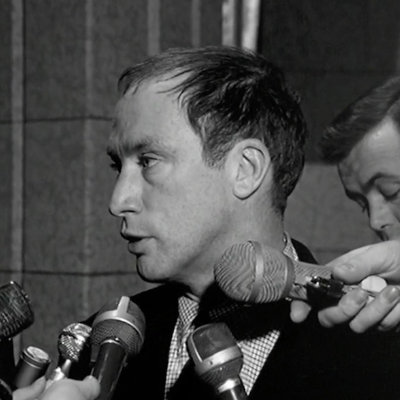
Shortly after, in 1967, the legalisation of these aforementioned homosexual acts (when performed in private) was proposed by then-Justice Minister Pierre Trudeau, announcing the sweeping reform to the Civil Code in his famous “No place for the state in the bedrooms of the nation” speech. As part of the Omnibus Bill, the decriminalisation of homosexuality was discussed in tandem with that of abortion and the sale of contraceptives, which for the first-time considered sexuality and reproductive rights under the same umbrella of civil liberties in Canada. To cite the original 1967-editorial from The Globe and Mail, which sampled extracts from a report submitted to the Commons Committee on Health and Welfare by the Canadian Catholic Conference:
“We wish to make it abundantly clear that the modification of civil law in no way implies the modification of God's moral law. No matter what civil law may state, divine law remains intact.”
"There are, moreover, instances in which it would not serve the common good to translate moral laws into civil laws. For example, fornication between consenting adults is certainly sinful in the eyes of God. Yet civil law does not forbid this moral offense."
The convergence of the legislative acceptance of homosexuality and the easing of access to birth control tentatively raised the possibility that the two issues could one day be officially discussed in tandem with one another. However, said ‘divine law’ would still take some time to fully lose its influence: it was only in 2002 that same-sex couples were granted adoption rights, and for male-male couples surrogacy remains prohibited by Article 541 of the Civil Code which retains this legacy of filiation in a case unique to Québec set in the rest of Canada: « toute convention par laquelle une femme s’engage à procréer ou à porter un enfant pour le compte d’autrui est nulle de nullité absolue » [“Procreation or gestation agreements on behalf of another person are absolutely null”].
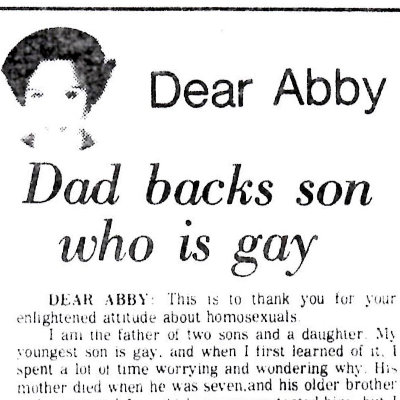
Returning to opinion pieces some ten years later in 1977, a heartfelt piece from the Dear Abby advice column in the Montréal Gazette explores a father’s experience of raising a gay son, in the specific context of losing his wife – his son’s mother – some years ago. Paternal anxieties are explored and ‘reasons’ explaining his son’s latent homosexuality are hypothesised and swiftly rubbished – for this is an outpouring of the ‘wonderful feeling’ of love for one’s gay child and family. Moreover, there is a nod to the reclamation of filiation from the state: the writer’s second grandson, he writes, is named after his gay son, and the anonymity attached to the author almost suggests a triumphant queer universalism attached to his message of hope for his family’s future with him and his legacy living on through it.
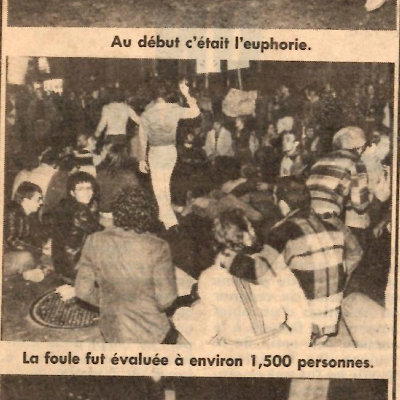
That said, the following month in October 1977 we are once again reminded of the ground yet to be covered in Québec’s gay civil rights liberation movement. In a way almost prescient of the epidemiological trauma yet to come in the following decade, which no doubt shifted an already heavily-opinionated arena on queer parenting, the Journal de Montréal presents us here with images of the responses to the numerous police raids on queer bars, clubs, and hangouts in downtown Montréal. “On est sain, c’est le système qui est malade” [“We’re healthy, it’s the system which is ill”] read their placards, drawing widespread attention to police brutality against the community following the Truxx raids on October 22nd, and causing readers to reflect on the brokenness of an ailing system which continued to exclude its queer members from officially beginning families of their own.
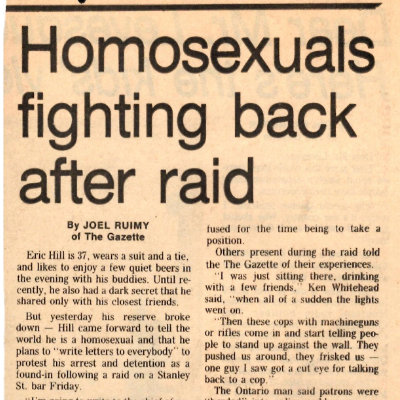
In the same month, on October 27th, 1977, opinion pieces and the role played by local newspapers took a further interesting turn, particularly through the way in which articles were positioned alongside one another as pragmatic, opinion-shaping devices. Page 3 of the Montreal Gazette details some responses to the Truxx raids, wherein 136 GBT men were arrested at gunpoint and held “20 to a cell” for up to twenty hours, after which “all were given venereal disease tests by the city health officers”. The forced imposition of sexual health testing upon prisoners suggests not only a pathologically fear-based approach to the gay community, but once more signals that questions of sex and/or reproductive potential have been supplanted from themselves to the state. More interestingly, however, on the reverse of this same article, is the return of the infamous opinion piece: Ernhofer’s headline “Dear Mr. Lévesque: Here’s the kids’ view” on page 4 once more invokes the unity of child and nation – ““Why should Quebec separate? I mean, it’s our country. Why should you of all people want to destroy our unity?” That’s how a letter by 16-year-old Vida Vaitiekunas – a Hamilton high school student – begins” – as being once again under threat by the acceptance of the 2SLGBTQ+ community. Though not explicitly written as such in this article, the sequential positioning of the narratives of gay debauchery > fears of Québec separatism from a child’s perspective compounds this idea that children need to be protected from the rise of queer visibility and future parental rights as much as possible for the good of the nation (an idea propagated in the 1966 Photo Journal article which began this timeline).
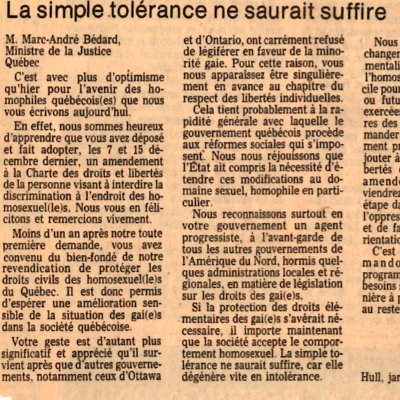

Opinion pieces further intensified debate on how society should approach 2SLGBTQ+ parenting in Québec throughout 1978. This year’s dialogue, however, began to shed light on more progressive stances towards the prospect of gay Quebeckers raising children. Yvon Thivierge, writing in Le Devoir on 2nd February 1978, advocates the need for “un programme d’information sur les besoins sociaux des gai(e)s de manière à permettre leur integration au reste de la société” [“an awareness campaign centred on gay social services in order to help the community integrate with wider society”], of which parenthood and family planning services would one day form part. In August 1978, however, La Presse featured a more vehement defence of the gay community, this time attacking the press’ oft-returned to conflation of homosexuality with dangers to young people. Daniel de Lessard Begin poured scorn on journalist Claude Carfantan’s reporting of the murder of a child, who was “sadiquement assasiné par des homosexuels à Toronto” [“sadistically murdered by homosexuals in Toronto”]. He remarked that the sexuality of murderers is never made the central headline when those involved are heterosexual, and he powerfully closes his scathing critique of the status quo of this gay moral panic with this witty jibe:
“Avec un peu plus de zèle, M. Carfantan pourrait sûrement devenir l’Anita Bryant du Québec” [“With a little more zeal, Mr Carfantan could surely become Québec’s answer to Anita Bryant”]
… Bryant being the American anti-gay figurehead of the 1977 Save Our Children alliance in the United States.
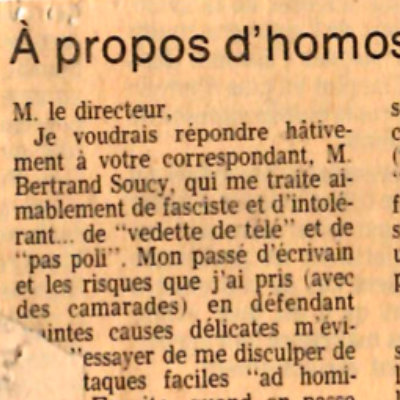
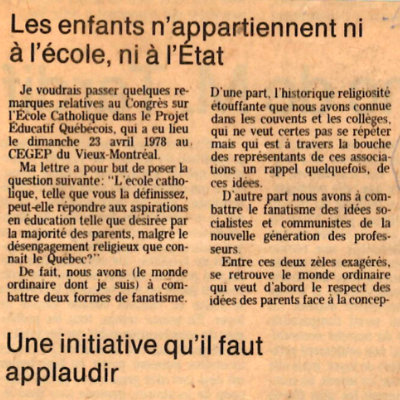
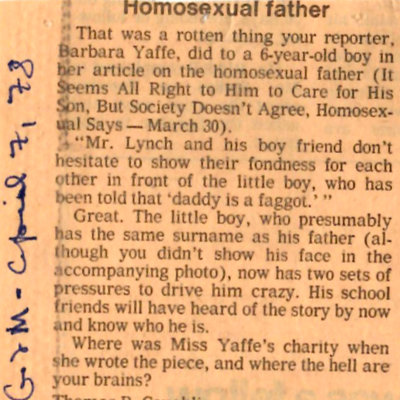
More mixed, or even ambivalent approaches, were still apparent also. In a February 1978 article of Le Devoir, writer Claude Jasmin announces that ““Le droit d’être homosexuel” est une farce. On l’est ou l’est pas; ça n’a rien à voir avec les droits” [“The ‘right to be gay’ is a farce. You’re either gay, or you’re not; it’s got nothing to do with rights”], before comparing this “right” to be gay to the “right” to one’s claim to disability, religion, or ethnicity, a problematic conflation which ultimately advances the cause of no minority group. Moreover, in a May 1978 contribution to Le Devoir, Nicole G. Larocque notes that it is for the best that Québec’s children “appartiennent aux parents et non pas à l’école ou à l’État” [“belong to their parents, not to school or the state”] faced with the apparently indomitable rise of socialist ideals of the nation’s schoolteachers and the “historique religiosité étouffante” [“stifling religiosity of the past”] which haunts provincial politics. Again, we note the constant reversion to the theme of the child, and the complex of people having the moral obligation to save the next generation from the perils of non-normative sexualities and genders. Thomas B. Coughlin’s opinion piece, titled “Homosexual Father” in a July 1978 edition of the Gazette de Montreal, claims it was a “rotten thing” to effectively out a schoolchild as having a gay father and who will now have “two sets of pressures to drive him crazy”. Shortly before the timely creation of the Association des pères gais de Montréal, this op-ed perhaps shows that while same-sex parenting was discussed – albeit reticently – it was perhaps best left in the shadows, away from the society which readers wrote so frantically to protect.
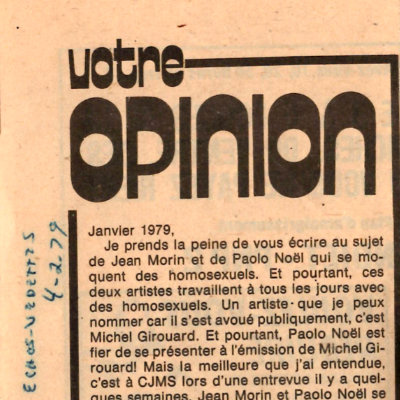
Before turning to the second section of this timeline, wherein we explore more organised group-based approaches to legislative challenges, I turn lastly to one final opinion piece which again comes to the defence of journalist Michel Girouard. In a February 1979 edition of Échos Vedettes, a writer comes to the defence of Girouard (who married his partner Réjean Tremblay in 1972, despite same-sex marriage being unrecognised in Canada), and calls out the jibes received from heterosexual stars in the province, who he points out are often “les malheureux, toujours à la recherche du bonheur” [“the miserable, on the constant quest for happiness”]. We witness here, then, a shift in the function of some opinion pieces: their role becomes that of defending public figures outwardly living and paving the way for equal rights, perhaps as a development from speaking for those more anonymous voices and testimonies otherwise not reached by the media spotlight. Defending a married gay couple could be the first step in advocating their access to creating a family unit of their own: the 1980s, however, is when we really start witnessing tangible progress through organised programmes and community groups which paved the way for true familial, legislative change.
Spanning roughly a decade, this section explores some of the more organised community-level responses to the growing visibility of queer paternity in Montréal and further afield, especially from those who sought to raise consciousness of the legislative obstacles faced by 2SLGBTQ+ parents and children alike. What becomes apparent is a move towards shifting public perception away from the idea that gay parents and/or children represent(ed) a menace to the family unit: that is, with the family accepted as a cornerstone of promoting good moral order as that which was fundamental to Québec’s continued survival for generations to come, said futurity can and should involve 2SLGBTQ+ lives and voices as part of this family-as-nation discourse so unique to the province. As we shall see, the 1980s was the decade in which public debate shifted from the more subdued or even anonymous arena afforded by newspaper opinion pieces: instead, we begin to see more official platforms in which the rights to the family on the part of the queer community are championed to sway legislative outlooks in the future (including paving the way for equal marriage and adoption by same-sex couples).
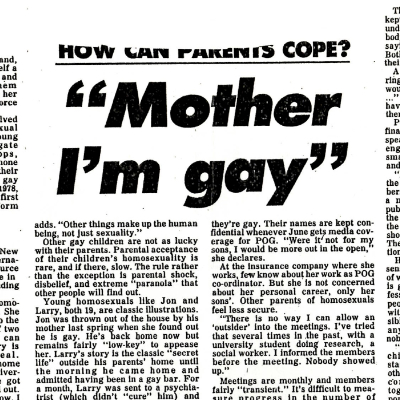
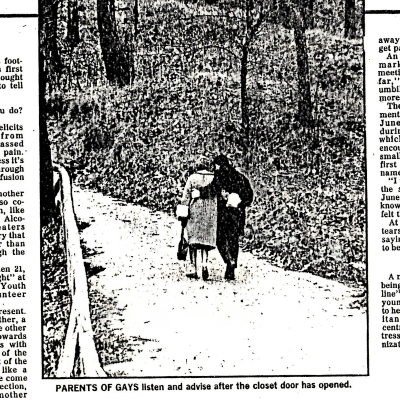
We begin November 1979, with an article published in Toronto’s Sunday Sun newspaper. Even for a more conservative-aligned platform, the immense reach achieved by the piece cannot be understated. The narrative arc of the text begins by resonating with (and perhaps even ridiculing) the gay panic that is attached to the parental fear that a child’s homosexuality is somehow their ‘fault’. Dali draws on the gift of hyperbole to evoke and perhaps satirise the fear attached to gayness infiltrating the family: “Homosexual.”, the third paragraphs opens, evoking “for most parents, pain”. Soon follows the introduction of the Parents of Gays support group, and testimonies of those (predominantly mothers) who started Toronto’s own branch of the network. Perhaps most fascinating about this piece – beyond its extended reach to a perhaps more conservative readership – is the message and the more personal, closing reflections it carries: June notes that “Only mothers have come [to the Parents of Gays meetings] so far”, a reason she attributes to being “probably an umbilical cord thing that makes women more inclined to participate”. She closes by imploring her desire to simply “reach out to other parents and say: My son is gay. It’s not that bad.”. This musing on the connection between the gay son to the umbilical cord seems to deride the Oedipal complex cited in the 1966 Photo Journal piece, in which Voyer espoused with his outlook the much-discredited view that male homosexuality is a result of “une solution négative du complèxe d’Oedipe”. Above all, it is the raising of visibility of the Parents of Gays network to a new readership – both through these testimonies and by providing useful closing contact details – which marks a turning point in the role of newspapers and op-eds entering the next decade.
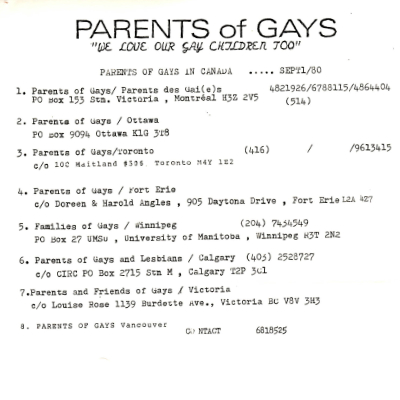
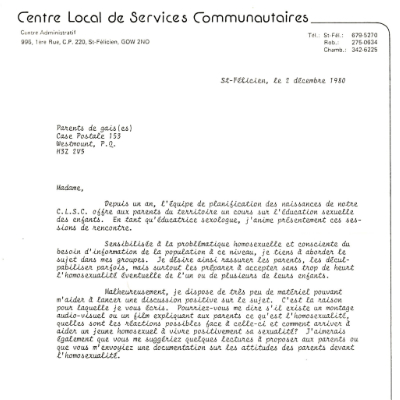
Moving to September and December 1980, we see the Montréal branch of Parents des Gai(e)s (PoG) in fully-contactable operation in the city. In the case of the latter month, we are shown an example of a Centre Local de Services Communautaires reaching out to the local PoG contingent to help them in their own outreach efforts – an example of the seeds of positive, legislative change being sowed arising from increased public visibility of groups in need of representation. In this case, support services for parents of gay children – particularly those reaching out to CLSCS who may be struggling to accept their child’s sexuality – underline the lack of materials on offer needed to sustain a positive dialogue between state health practitioners, parents, and children, and they call out specifically for audio-visual materials to help with this endeavour. This is one of the first examples I came across in the Archives which explicitly demonstrated a desire on the part of the state (the CLSCS) to engage proactively with intersections of sexual identity and family life through a variety of interventions – importantly, those beyond psychiatry.
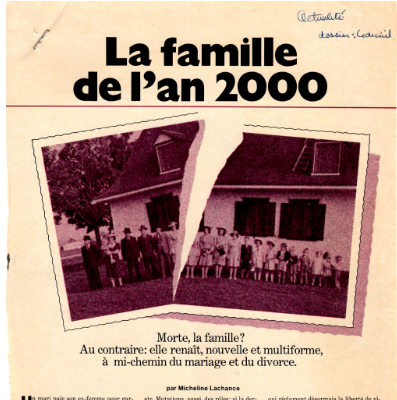
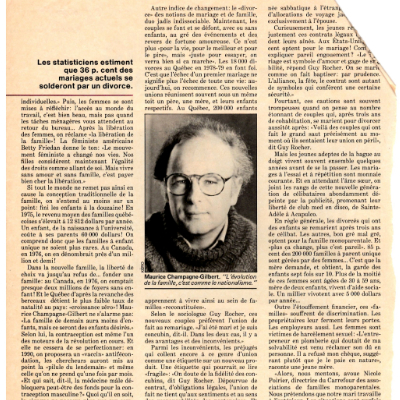
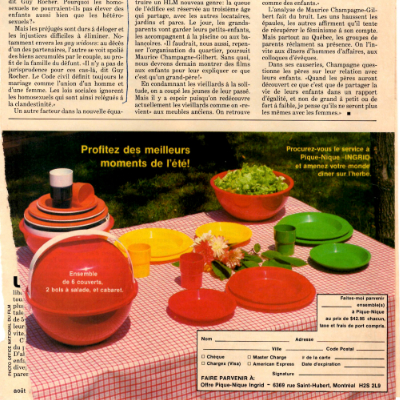
In an August 1981 edition of L’actualité magazine, an interesting piece appeared written by Micheline Lachance which prophesised the future of the Québécois family unit some two decades later in the year 2000. Uncovered in the Dossier Opération Liberté file (F0017: S7, D116) for the Association pour les droits des gai(e)s du Québec, the article lingers on the potential “renaissance” of the family, wherein “les hommes doivent apprendre à être pères 24 heures par jour” [“men have to learn how to be fathers 24/7”], women would have “la liberté de choix [qui] va jusqu’au refus de… fonder une famille” [“the freedom to choose whether or not they want a family”], and wherein questions could be raised as to “pourquoi les homosexuels ne pourraient-ils pas enlever des enfants aussi bien que les hétérosexuels?” [“couldn’t homosexuals raise kids just as well as heterosexuals?”] faced with the 1980s laws which “ignorent les homosexuels qui sont ainsi relégués à la clandestinité” [“ignore the gay community which is so often relefated to the shadows”]. Another interesting feature here is the link made between nationalism and the evolution of the family unit: “Il y a ceux qui la [l’évolution de la famille] perçoivent comme un bienfait, les autres qui la refusent parce qu’ils s’en méfient” [“There are some who perceive it as a benefit, others who refuse it as they don’t trust it”]. Though written in a hypothetical tense, Lachance’s text did have some truths: births indeed fell from 14.5 per 100,000 of the population at the time of writing to 10 per 100,000 in the prophesised year 2000 ; in 2016, 81% of the one million children living in monoparental families in Québec lived with their mothers, while the remaining 19% lived with their fathers , with joint custodial rights giving rise to more fathers raising children alone; whilst, post-2000, support for Québec’s nationalist project dwindled in an apparent parallel with the number of families engaged in conventional nuclear structures as society became distrusting of the ways in which taxation and provincial social services were managed.
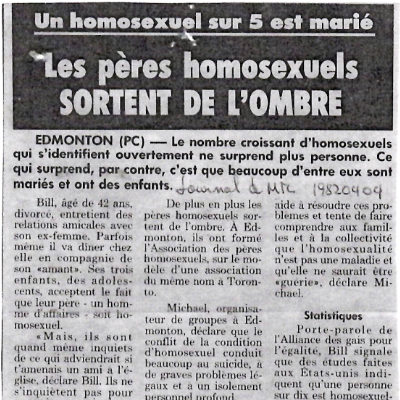
Moving through to September 1982, we begin to see growing public attention being paid to gay fathers and their journey towards more equal recognition in the familial structure of Québec. This article from the Journal de Montréal introduces the Association des pères homosexuels network, and supposes that approximately 10% of gay men have married and had children. Whilst this may be an uncertain or statistical approach to the realities at hand, this article lays fresh ground in the call to normalise the role of the gay father in family life, even after a rupture in romantic or emotional unions. This is a remnant we will see comes to life in later archival finds, particularly those found in REZO Santé’s 2013 online video library discussing queer parent-and-childhood (to which we will return later).
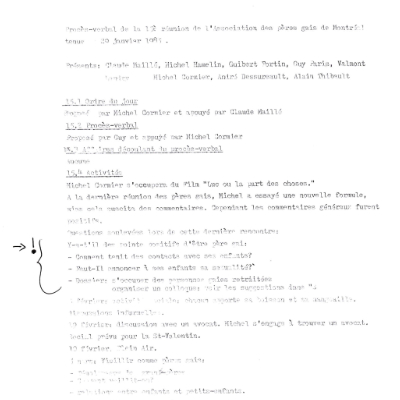
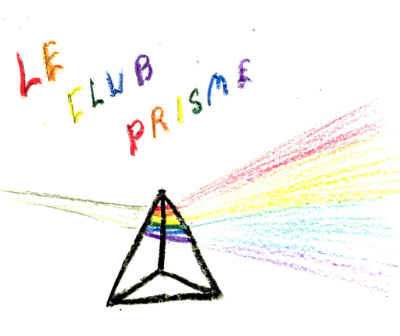
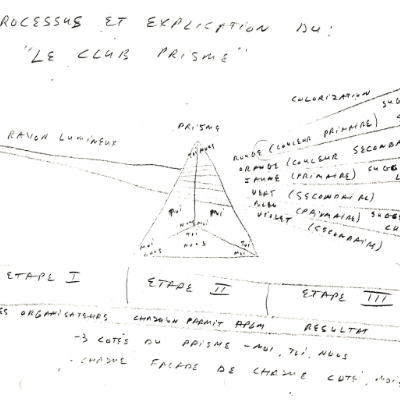
These calls for gay parental inclusion and welfare were strengthened by the Association des pères gais de Montréal in January 1985: here, in an extract from the minutes of their 15th meeting, we can see that future meetings were planned to respond to pertinent questions raised along the same theme of family relations from the previous session, including “Comment tenir des contacts avec ses enfants?” [“How do you stay in touch with your children?”], “Faut-il annoncer à ses enfants sa sexualité?” [“Should you tell your kids about your sexuality?”], and “Y-a-t’il des points positifs d’être père gai?” [“Are there any good points about being a gay dad?”]. Also included in these minutes is the Association’s aspirations to apply for their letters patent, which would eventually be granted in 1990. Also in 1985, the plans for the “Club Prisme” were drafted, which sought to address the social and cultural integration of gay fathers and their families, and to help make the Association into a more outward-facing community group with greater impetus in enacting legislative changes.

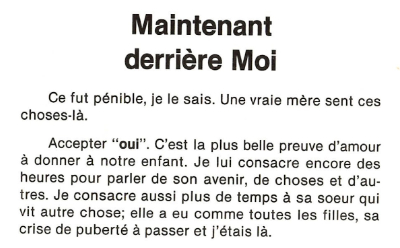
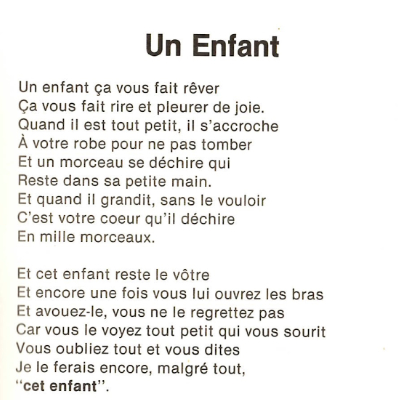
In 1986, Marie Mayrand published her ground-breaking memoir Le combat de la mère d’un transsexuel. This was a foundational piece of literature in Québec which – in Mayrand’s words – « si cela pouvait aider une seule mère ou un seul père à comprendre et accepter, mon but serait atteint » [“If this could help just one mother or father understand and accept [their child], then my job here is done”] (p.7). The touching memoir does not shy away from the realities faced by both mother and transgender child during the 1980s: we follow a journey of a mother’s initial turmoil in understanding and raising a transgender child (« Je le revois encore qui me regardait avec ses grands yeux, sa bouche ne disait rien. Mais moi sa mère, je lisais dans ses yeux ces mots: “Tu ne peux pas me comprendre, c’est plus fort que moi. Aides-moi, Maman » [“I saw him looking at me in silence with his big eyes. But as his mother, I could tell by the look in his eyes what he wanted to say: “Mum, you don’t understand, it’s stronger than me. Help me, mum”] (p.44), as well as her moments of harmony and ultimate acceptance of her daughter (« Cet être à qui j’ai donné la vie, je l’aime quelle que soit sa vie. Elle vit, elle respire, elle est heureuse, son calvaire est aussi terminé » (p.65); « Accepter « oui ». C’est la plus belle preuve d’amour à donner à notre enfant […] Je dis merci à Dieu car c’est dans la souffrance que se forme un être chaleureux et charitable » (p.69)) [“This being to whom I gave birth, I love her however she lives her life. She’s living, breathing, happy: her ordeal, too, is over” […] Acceptance and saying “yes”: That’s the most genuine way to show love for one’s child … I thank God because it’s in our suffering that He has made such a warm, charitable person”]. The textual element of the autobiography closes with Mayrand’s stunning poem Un Enfant (p.73), which retains an element of universiality in gender and sustains the undying bond between mother and child through a queer lens. Indeed, writing in Queerly Phrased: Language, Gender, and Sexuality (1997), Anna Livia cites Le combat as a striking example of how the French language is used to relate to one’s own understanding of gender identity, and that of others. She writes:
“…two biographies, Histoire de Jeanne transsexuelle by Catehrine Rihoit (1980) and Le combat de la mère d’un transsexuel by Marie Mayrand (1986). In each case, although the transsexual asserts that she has been female since birth, she alternates between masculine and feminine gender concord with regard to herself, indicating that the situation was in fact far more complex. The two third-person accounts […] also switch gender reference. Mayrand, for example, whose son changed from a masculine to a feminine identity, describes her offspring in the masculine until the moment she herself accepted that he was a she. After this point in the narrative, she uses feminine concord…” (p.353)
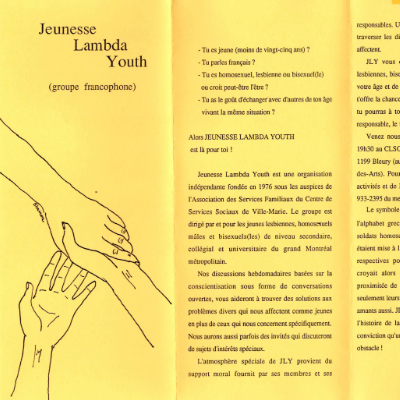
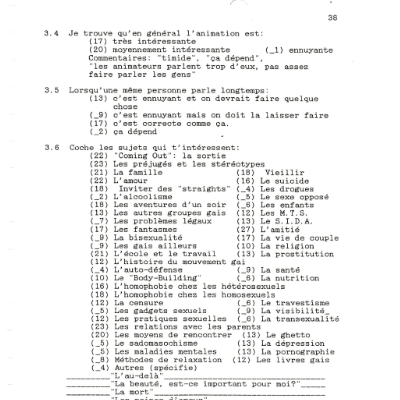
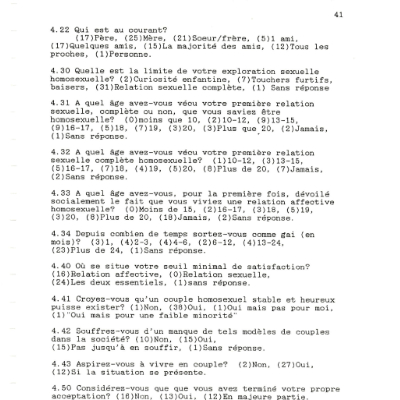
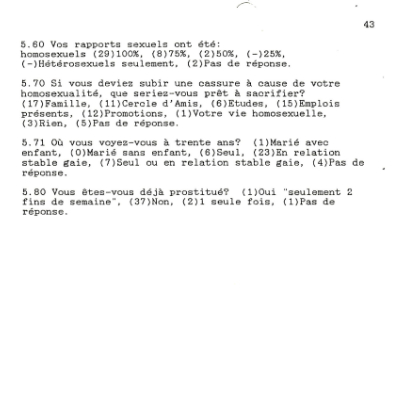
Continuing this theme of queer child-family interaction, I turn now to a study conducted by Märc Guay in March 1988 which examined the public awareness and recruitment strategies utilised by the Jeunesse Lambda Youth project. Jeunesse Lambda began in 1976 as an Anglophone social services organisation (and in September 1987 as the Francophone branch) which sought to support, welcome, and educate young people aged 14—30 as they grew to understand their LGBTQ2S+ identities; JLY is still going strong today. As suggested by the attached pamphlet, the group prides itself on inclusivity, welcoming all, and meeting regularly as part of a sustained support framework, keeping no list of registered members so that people are free to come and go as they please. Guay’s useful evaluation sheds insight into some of the drivers which encouraged service users to attend JLY meet-ups; interestingly, many responses revolve around queer youth’s perception on the part of their families and, in particular, their mothers. Of the 41 respondents to Guay’s questionnaire-based study:
These responses again suggest the pressing need for further research and social interventions on the part of the provincial government to help integrate the experiences of queer youth in formative stages of development alongside their families. These would later be enacted in the form of legislative changes enabling this generation of queer youth to start families of their own through later equal marriage, adoption, and family legislation. Indeed, the organisation went on to receive recurrent funding through the government’s Programme de Soutien aux Organismes Communautaires scheme, securing the longevity of this important organisation in the long run.
In 1989, even popular music in Québec offered its two cents to the debate around queer paternity, and the right for same-sex couples to have children. Although Bill 84 which legalised same-sex adoption was not enacted in Québec until 2002, the comedy and often satirical Québécois group Rock et Belles Oreilles released their song Un enfant de toi as part of their album Pourquoi chanter?, a song in which two men declare their love for one another and their desire to have a child together. Available to listen to here, the lyrics offer a more humoristic but equally scathing take on the legislative restrictions which then prevented same-sex couples from having or adopting children of their own. Indeed a parody of Québec’s longstanding rules on filiation and the “projet parental”, the same album features one of their most famous hits, Bonjour la Police, which ridiculed the perceived inefficacy and laziness of the police force in Québec. Again, this perhaps strategic placement of social commentary on the unfitness for purpose of state methods of control – be it the police or facilitating equal access to the 2SLGBTQ+ community to start families – could have procured legislative change as a means of reflecting shifting popular values.
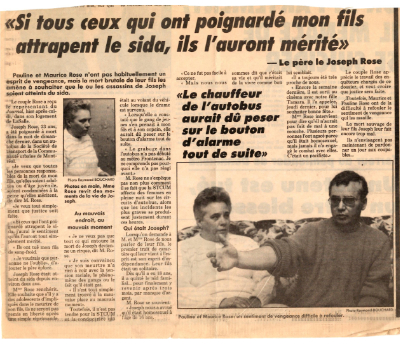
Also in 1989, newspaper attention to the chilling murder of Joseph Rose featured reactions by his parents. Rose, a prominent gay rights and HIV/AIDS activist and founder of Dawson College’s LGBT+ association, Etcetera, was brutally murdered on his way home in Montréal on March 19, 1989. In a newspaper report from Le Journal de Montréal documenting the aftermath of his killing, his parents remember Joe as someone who “would never hurt a fly” who was simply “in the wrong place at the wrong time”. The homophobic slaying rallied the gay community in Le Village and beyond, though it is the headline of this text which encapsulates the agony of this era of AIDS panic and the role it played in family relationships. Though not a vengeful couple, the paper writes, the parents add that while they found their son’s homosexuality difficult to accept at first, all they wanted was for him to be happy, and that if those who shot him contracted HIV as a result of being in contact with his blood, “ils l’auront mérité” [“they’d deserve it”]. Such was the weaponization of the as then-misunderstood virus which emblematised the era and beyond, though which was rarely documented in the arena of parent-child relationships.
Also in 1989, newspaper attention to the chilling murder of Joseph Rose featured reactions by his parents. Rose, a prominent gay rights and HIV/AIDS activist and founder of Dawson College’s LGBT+ association, Etcetera, was brutally murdered on his way home in Montréal on March 19, 1989. In a newspaper report from Le Journal de Montréal documenting the aftermath of his killing, his parents remember Joe as someone who “would never hurt a fly” who was simply “in the wrong place at the wrong time”. The homophobic slaying rallied the gay community in Le Village and beyond, though it is the headline of this text which encapsulates the agony of this era of AIDS panic and the role it played in family relationships. Though not a vengeful couple, the paper writes, the parents add that while they found their son’s homosexuality difficult to accept at first, all they wanted was for him to be happy, and that if those who shot him contracted HIV as a result of being in contact with his blood, “ils l’auront mérité” [“they’d deserve it”]. Such was the weaponization of the as then-misunderstood virus which emblematised the era and beyond, though which was rarely documented in the arena of parent-child relationships.
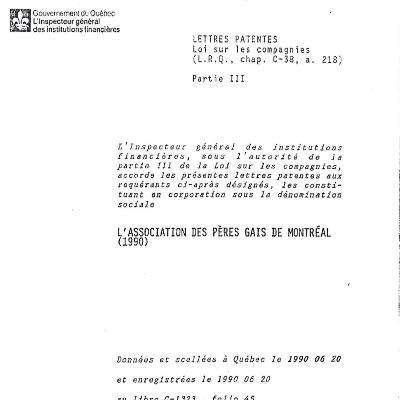
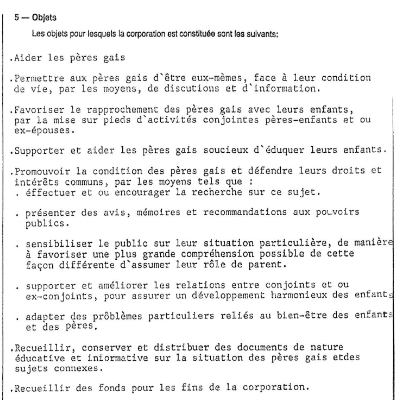
This section moves towards the new millennium, examining some of the most substantial legislative changes to affect same-sex couples in Québec, and their rights to begin families of their own. Of course, this decade left many in the community reeling from the impact of the HIV/AIDS epidemic which first arrived in Canada in 1982. It appears that the 1990s was the decade in which legal recognition of same-sex couples and gay rights in Québec really began to ramp up: as writes Serge Fisette, titling chapter seven of his 2021-book L’homosexualité masculine au Québec as “1990-1999: Vers la légalité”, “le 20 juin 1996, le projet de loi C-33 – ajoutant l’orientation sexuelle à la Charte canadienne des droits et libertés parmi les motifs de discrimination interdits – est approuvé par sanction royale […] Quelques jours plus tard, une decision de la Cour supreme du Canada fait en sorte que les couples homosexuels soient inclus dans les unions de fait" [“On June 20, 1996, Bill C-33 - adding sexual orientation to the Canadian Charter of Rights and Freedoms as a prohibited ground of discrimination - was approved by Royal Assent... A few days later, a decision of the Supreme Court of Canada ensured that same-sex couples were included in common-law relationships”] (p.203). In addition, the Coalition des familles LGBT was formed following the merger of l’Association des Mères Lesbiennes du Québec and the Papa-Daddy Group (p.208) and, in June 1990, L’Association des pères gais de Montréal received its letters patent from the Québec government. An objective of theirs since 1985, this legal instrument specifically mandated the group’s aims to “promouvoir la condition des pères gais et défendre leurs droits et intérêts communs” [“promote the wellbeing of gay fathers and defend their rights and common interests”] which they continue to do to this day. More recently on their social media channels, the APGM collaborated with Les Chroniques de Montréal to produce this podcast, exploring how the Association helped Gilles, a gay father, “come out” aged 45 when married with three children.
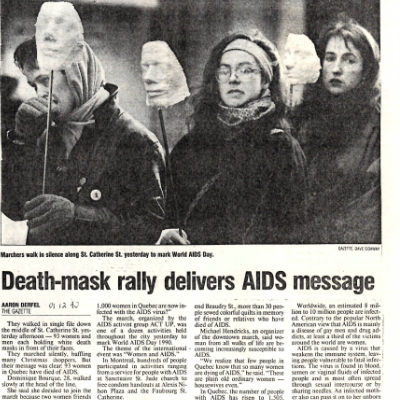
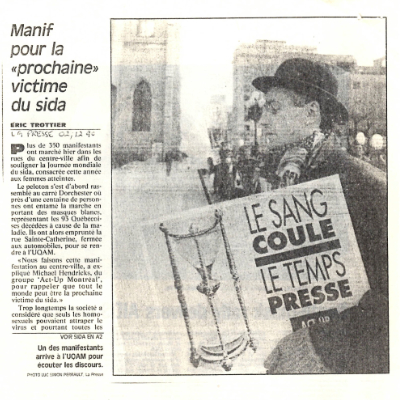
In December 1990, marking World AIDS Day, the Montréal Gazette and La Presse covered the “death-mask rally” which drew attention to the awareness campaign of that year’s AIDS Day – that women, too, can contract HIV. This marked one of the first occasions that HIV was no longer publicly shown as just a “gay” disease: “An infected mother can also pass it on to her unborn child […] one-third of Québec women infected with HIV have passed the virus to their children”, concludes The Gazette piece, whilst La Presse concludes that “Trop longtemps la société considère que seuls les homosexuels peuvent attraper le virus et pourtant toutes les femmes sont des victimes potentielles” [“For too long, society has believed that only gay men can contract the virus, despite women also being susceptible”]. Whilst this style of reporting still attributes a form of guilt to contracting the virus, this is still one of the earliest examples in epidemic’s press-reporting that shifts focus away from the homosexual community, and may give rise to the wider public paying more attention to the threats posed by this non-discriminatory disease which could indeed afflict traditional nuclear families. Currently on display at the Archives gaies du Québec, the AIDS Committee of Thunder Bay’s poster depicting a silhouette of a pregnant woman and the caption “Women can get AIDS” & “Women can give AIDS to their babies” (also from 1990) further demystifies HIV as a virus which can – and does – concern non-2SLGBTQ+ communities and families.
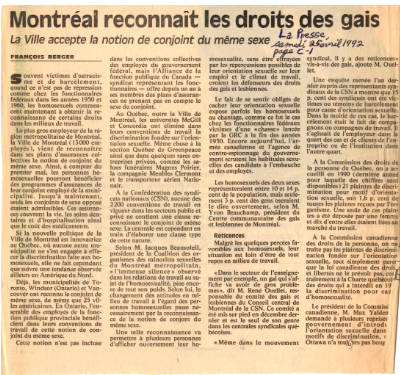
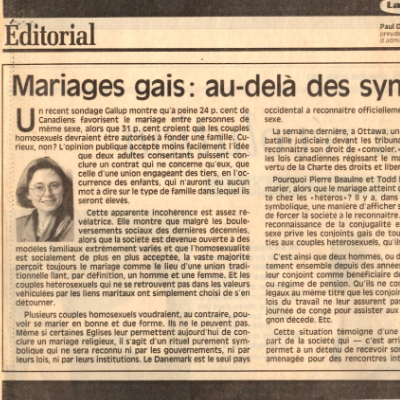
In anticipation of legislative changes to same-sex union recognition through loi C-33’s amendment in 1996, in April 1992 La Presse ran a story covering the city of Montréal’s landmark recognition of same-sex unions with respect to employment, healthcare and insurance legislation. From May, it adds, same-sex partners of the Ville de Montréal’s employees will be entitled to the same life insurance benefits as straight couples, a marker of the “immense silence” being lifted from the lives of 2SLGBTQ+ employees in the workplace. Indeed, this would pave the way for later changes to same-sex adoption rights and paternity leave in 2002. The article concludes that “Ottawa n’a toujours pas bougé” at the time of writing, the attitudes towards which are reflected a month later in an editorial in a May 1992-edition of the same paper. Here, the writer calls out the “hypocrisie de la part de la société” which, paradoxically – she argues – would be happier with gay couples getting married than it would them having children. The time had come to put an end to same-sex couples being invisible in the eyes of the law, she writes, and that measures beyond the symbolic were needed to ensure that inheritance, paid leave, and workplace pensions benefitted the sizable minority of same-sex, coupled workers in Québec, which would soon extend to those of their families, too.
On the subject of marriage and same-sex unions, Stéphane Baillargeon responded in May 1996 to the implementation of the loi C-33 amendment that month. His Église rose editorial cited some examples of homophobia in the Church which had lingered over debate on same-sex union legislation in Ottawa for decades: for example, the Bishop of Alexandria-Cornwall Eugène P. Larocque argued that removing LGBT anti-discrimination legislation would “aura pour effet d’approuver légalement le style de vie des homosexuels, des lesbiennes et même, disons-le franchement, des pédophiles” [“will have the effect of legally sanctioning the lifestyles of homosexuals, lesbians and even, frankly, pedophiles”], whilst Archbishop of Québec Maurice Couture provided another paradoxical opinion that “Il faut respecter la personnalité de l’homosexuel. Mais j’ai des réticences sir l’attribution des droits qui ont une repercussion familiale ou sociale” [“We must respect the personality of the homosexual. But I have reservations about the attribution of rights that have repercussions for the family or society”]. This piece draws attention once again to the farcical standpoint that homosexuality – or acting upon it – is an infringement upon the natural order by way of corrupting minors. Figureheads in Canadian and Québécois society clearly still had an influential role in shaping legislative measures, even when Parliament was making small steps to legally recognise civil unions which would one day pave the way for a more egalitarian adoption and family-raising framework.

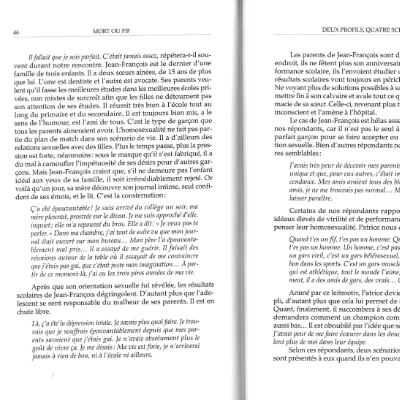
The year 2000 saw the publication of Michel Dorais’ ground-breaking study Mort ou Fif: La face cachée du suicide chez les garçons, which was the first French-language publication to examine the intersection between two societal taboos: male (youth) suicide and homosexuality. Again, many of the testimonies uncovered in the text centre around young gay men’s anxieties surrounding how society and, by proxy, their parents perceive them. “Il fallait que je sois parfait. C’était jamais assez […] [Il] craint que, s’il ne demeure pas l’enfant idéal aux yeux de sa famille, il soit irrémédiablement rejeté” reports Dorais (p.46); “Or, la perte du soutien et de l’amour de sa mère peut avoir des conséquences dramatiques […] Si, elle, elle ne comprend pas, qui le fera? Steve relates: Ma mère, je la voyais comme une sainte; c’était ma mère qui donnait toute l’affection chez nous” (p.60) [“"I had to be perfect. It was never enough [...] [He] fears that if he does not remain the ideal child in the eyes of his family, he will be irretrievably rejected" Dorais reports (p.46); "However, the loss of his mother's support and love can have dramatic consequences [...] If she does not understand, who will? Steve relates: "My mother, I saw her as a saint; she was my mother who gave all the affection in our home"]. This emotionally charged narrative sensitively explores the intricacies of mother-queer son relationships, and reads as a treatise on the need for better social services integration and legal recognition of queer youth’s right to exist in Québec and beyond. It closes powerfully, with a message seemingly directed towards the state:
“Le suicide chez les jeunes homosexuels ou bisexuels est la consequence directe et prévisible de l’absence de place qu’ils ont dans notre société. Tout, ou presque, concourt à leur passer le même message: on préférerait qu’ils n’existent pas. Certains d’entre eux ne comprennent que trop bien le message…” (p.105) [“Suicide among young homosexuals or bisexuals is the direct and predictable consequence of the lack of place they have in our society. Everything, or almost everything, concurs to give them the same message: we would prefer that they don't exist. Some of them understand the message only too well..."]
Such is the pressing need for legislative change in recognising queer family units in Québec that narratives such as this one hold so much power. It is perhaps in the decade which follows that some more powerful legislation is enacted to empower and liberate the next generation of queer youth – and current 2SLGBTQ+ Quebeckers – to finally have full access to the right to a family of their own.
The post-2000s is when the rights to queer parenthood and family-raising in Québec really began to be enshrined into law. In 2002, article 521 of the Code civil du Québec was amended, creating the legal status of a civil union between two people, regardless of sex . This gave 2SLGBTQ+ people the same rights as married heterosexual couples to adopt children, and access to the affordance made by family patrimony laws. In 2004, Law 59 again modified the Civil Code to fully bestow same-sex marriage rights upon couples in Québec, the fifth jurisdiction in the world to do so, shortly before the Civil Marriage Act legalised same-sex marriage on a federal level in 2005. With these legislative changes came increased literary and media visibility, aimed at 2SLGBTQ+ (potential) parents, children, and the wider Québécois and Canadian public.
An example of one such intervention came in the form of Sylvie Giasson’s 2007-book Vivre avec l’homosexualité de son enfant, published by Bayard in Montréal. Her text – which follows on from her contribution to the 2005-paper Out and About: Towards a Better Understanding of Gay, Lesbian, and Transgendered Persons in the Workplace (available here) – offers a comprehensive yet concise guide which has the laudable task of being accessible to both parents and their children. Chapters feature testimonies from the part of mothers and fathers, and from the LGBTQ+ children at the heart of the book’s objective of addressing the struggles faced by their families. Chapter one, titled “J’ai perdu mon fils…”, for example, reveals in particularly harrowing terms one mother’s hardship in accepting her son’s sexuality:
Sébastien a 23 ans. C’est un homme. Et c’est encore mon enfant. Il n’y a pas si longtemps encore, qu’il sortait de la douche, torse nu, je regardais sa peau lisse et tendue sur des muscles onduleux et je me surprenais à penser que si cet homme gracile et fort est sorti de mon ventre, c’est que la vie est réellement un pur miracle. Il était beau, mon fils. Maintenant, lorsque je pense à lui, je ne peux m’empêcher de l’imaginer faisant l’amour avec un homme, ou plusieurs, qui sait, dans des positions sordides. C’est plus fort que moi, cette image m’obsède et me donne, a moi, l’impression d’être sale. Je n’éprouve que du dégout et de la honte. (p.23)
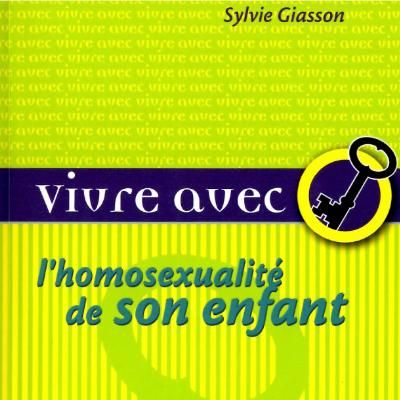
Later, in chapter five (Père et fils, rien ne va plus), we learn of a tender moment of mutual understanding between a father and his gay son following an argument over the use of the house telephone to call his chum:
J’ai dû m’assoupir aux petites heures du matin, le temps que Sébastien sorte de la maison pour repartir vers Montréal. À mon réveil, j’ai trouvé le café prêt à me réchauffer. C’est bien lui, cette marque d’attention envers moi. Sur la table de la cuisine, il nous avait laissé cette note :
« J’étais vieux, je suis venu au monde.
J’étais fermé, je suis devenue horizon.
J’étais de glace et je suis devenu rivière.
Peut-être ne comprendrez-vous jamais?
Mais je choisis de rester en vie comme je suis. »
Tout à coup, j’ai eu terriblement besoin de comprendre ce qui avait donné naissance à mon fils vingt ans après que, moi, je l’aie mis au monde. (p.50)
The book serves as a hugely useful toolkit for the parents of Québec, unsure of how to go about addressing questions surrounding their child’s sexuality. More importantly, perhaps, it encourages questions and curiosity from both sides of the relationship, bringing the issue out of the shadows to be talked about more openly. This book is available in the AGQ library.

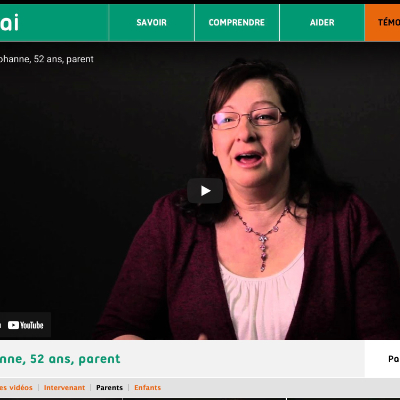
In 2013, REZO – a Montréal charity working to promote the health and wellbeing of gay, bisexual, and trans men – was commissioned by the Ministère de la Justice du Québec to produce the Mon fils gay online project, part of the governement’s Lutte contre l’homophobie initiative. Available on their website, Mon fils gai seeks to dispel myths about homosexuality for parents; offer practical support and advice to young men about their sexuality; and connect with social service organisations working in the prevention of youth suicide and harm. The site’s Témoignages section is particularly helpful, screening structured interviews with social workers, parents, and their young adult children, serving as a lasting resource for all such parties to consult even after its publication nearly a decade ago.
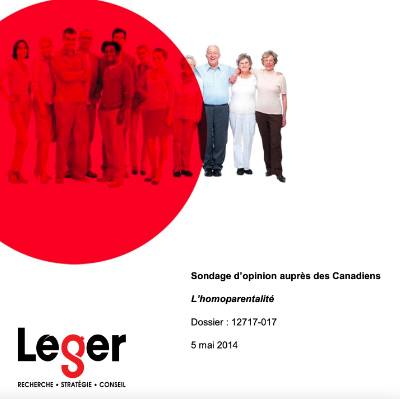
In 2014, the Canadian market research group Leger released the results of their study Sondage d’auprès des Canadiens: L’homoparentalité. This survey sampled 1,511 people across Canada, with respondents’ answers separated also into provinces and territories. Some interesting elements pertaining to Québec arose: 60% of Quebeckers were familiar with the term ‘homoparental families’, by far the highest figure in Canada (p.9); 25% of Quebeckers surveyed said that they had ‘never’ been witness to homophobia, again the highest in the country (p.12); whilst 85% of Quebeckers agreed with the statement ‘two people of the same sex can be just as good parents as those of the opposite sex’ – again, the highest figure country-wide. Whilst the study leaves readers to draw their own conclusions on the subject of 2SLGBTQ+ families and parenthood, it is perhaps significant that the general trend recorded among Québec-based respondents is one more of tolerance, openness, and acceptance of the notion and continued existence of non-heterosexual family units in the Canada of today.
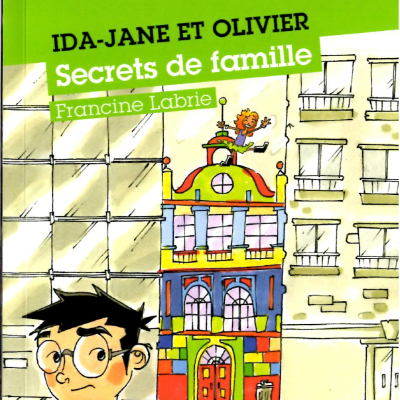
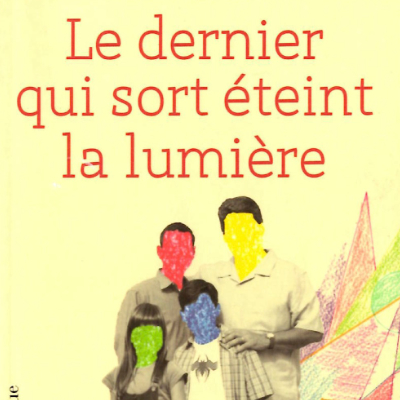
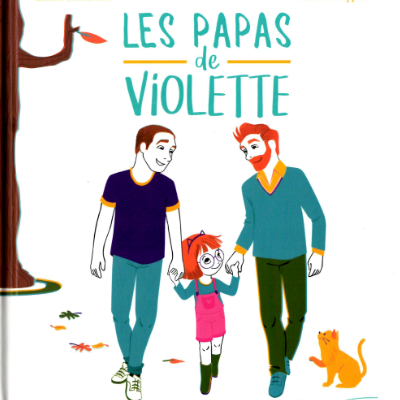
The next three books, released between 2014 – 2017 and available in the AGQ library, offer an invaluable resource for children in homoparental families in Québec who may feel like an outsider or “different” because of how their parents are perceived. Ida-Jane et Olivier (Francine Labrie, 2014) tells the story of two schoolkids, Ida-Jane who has two fathers, and Olivier, who has two mothers, and from whose perspective the story is narrated. They soon form a close friendship, batting away some snide comments from classmates with the help of their supportive teacher: the story concludes “Ida-Jane et moi, nous formons une bonne équipe! Je pense que, très bientôt, je l’inviterai chez moi. Elle s’entendra très bien avec mes deux mères!” [“"Ida-Jane and I make a good team! I think, very soon, I will invite her to my house. She will get along very well with both my mothers!"]. The second, Simon Boulerice’s Le dernier qui sort éteint la lumière (2017) recounts the story of two twins, Arnold and Alia, who are approaching their thirteenth birthday. They live with their two fathers – Papou and Poupa – who send them thirteen letters which will uncover who is their biological father. Throughout is a message of unconditional love, and homoparental triumphs over microaggressions in society, as well as the more legislative remnants which have yet to advance all attitudes. One such example is when the family asks for a family pass for a mini-golf session, only to be told they are not eligible for one: they are not, as the attendant puts it, “Ben… Une vraie famille, là. Genre: un monsieur, une madame et deux enfants…” [“Well... A real family, there. Like: a man, a woman and two children..."] (p.200). Also in 2017, Émilie Chazerand and Gaëlle Souppart’s Les Papas de Violette (published in France) was released, and is strikingly visual and accessible to young Francophone readers. Violette has two fathers and, as with Ida-Jane et Olivier, follows the same optimistic narrative arc of finding friends in school after being teased for her family life. Concluding, the authors write of Violette’s now-girlfriend: “Mais ce qu’elle préfère entre tout ça, ce sont mes deux papas” [“But her favourite part of all this is my two dads”]. What may have seemed unimaginable even only a decade previous now appears a tangible, readable, relatable reality: for the next generation of queer adults can now, too, aspire to raise a family of their own if they so desire.
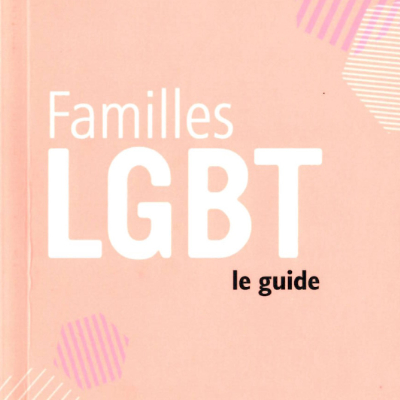
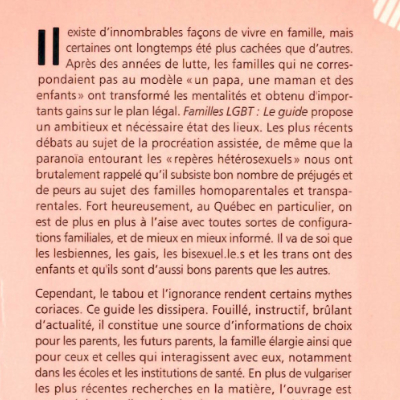
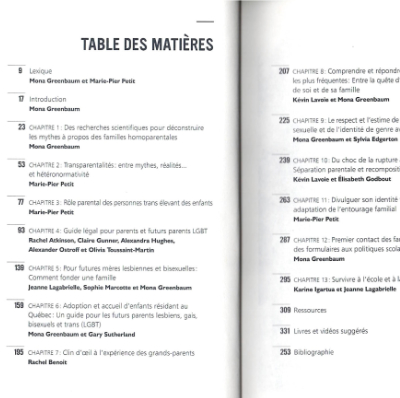
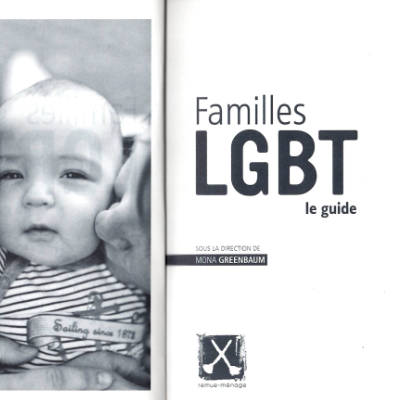
Mona Greenbaum’s edited collection Familles LGBT: le guide (2015) also offers an incredibly comprehensive overview – from a practitioner’s perspective – for 2SLGBTQ+ people navigating family life. Chapters range from legal insights (Chapter 4) and school life (Chapter 13), to lesbian and bisexual mothering (Chapter 5) and trans parenthood (Chapter 2). One of the most important contributions to the collection is evident in Chapter 1, wherein the author deconstructs and makes accessible Québec’s complicated rules on adoption, surrogacy, and parental contracts. Indeed, there are seven pages (24 – 30) dedicated to different homoparental family structures, ranging from assisted procreation and insemination (p.27), to coparenting (p.28) and the tricky rules regarding surrogacy (p.29) in relation to the Civil Code. This book is available in the AGQ Library.
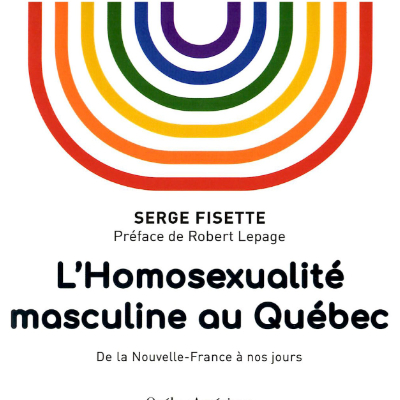
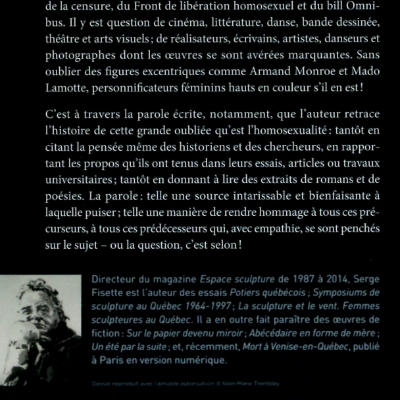
Serge Fisette’s 2021 book L’homosexualité masculine au Québec also charts – chronologically – some of the most significant advancements in gay male liberation in the province, with some reflections also on the family. Particularly in Chapter 8, Fisette raises the debate around civil unions vs. same-sex marriage (following the Bill 84 amendment which allowed same-sex adoption in 2002), and draws links to advancements in same-sex couples adopting and raising children of their own: on page 231, for example, Fisette cites Superior Court legal clerk Sherley Morin:
La loi reconnaît de plus qu’un enfant peut avoir deux pères ou deux mères et précise les règles de filiation des conjoints sur l’acte de naissance de l’enfant. Ces dispositions donnent à la loi son caractère unique dans le monde … « Une loi aussi complète, il n’y en a pas d’autres sur la planète ».
[“The law also recognizes that a child can have two fathers or two mothers and specifies the rules of filiation of the spouses on the child's birth certificate. These provisions make the law unique in the world... Such a complete law, there is no other on the planet".]
On which Fisette reflects:
Ce n’est pas encore le marriage, mais on s’en approche…
[“It’s not quite marriage, but we’re getting there…”]
To conclude this timeline, it is important to reflect on one of the most recent and impactful resources designed specifically to address the needs of Québec’s First Nations and Indigenous communities. The Indigenous LGBTQ+ and Two-Spirit report was released in 2021, and was commissioned by the LGBT Family Coalition and the Canadian Government’s Women and Gender Equality Canada to form part of the wider “Family diversity: Creating a regional and intersectional network” project. This report addresses some of the major barriers preventing these communities from accessing family support networks and social services when it comes to issues of sexual and gender identity: namely, that:
“Respondents from all four regional organizations expressed concern about using training services offered by non-Indigenous sources, because of concern about cultural safety and sensitivity. As they indicated, non-culture-specific training services are available, but the people teaching them are not conscious or aware of the realities of Indigenous people, their lives, and their communities, and consequently, are often unable to connect with Indigenous participants.” (p.20)
As a result, the report notes that mental health issues, poverty, racism, and unemployment – which already disproportionately afflict these communities as a remnant of colonial trauma and lack of adequate service provision – are in effect exacerbated by lacking levels of engagement and user-appropriate interventions. Indeed, there is a double layer of oppression upon Indigenous LGBTQ+ and Two-Spirit peoples: firstly, as result of Canadian society’s ill-acceptance of Two-Spirit identity and enforcement of gender and sexual binaries, and, secondly – and especially in Québec’s urban agglomerations – due to the strict provision of social interventions solely in French or English, and not in Indigenous languages.
This lack of appropriate engagement with Indigenous communities has only served to exacerbate the trauma arising from the residential schools system, wherein “heterosexuality became compulsory in the Indian Act with the imposition of patriarchal and heterosexist knowledges” (p.7), and created “institutionalized descent through the male line [which] simply ‘naturalized’ the heterosexual nuclear family within First Nations communities” (citing Cannon 1998 (10), p.7). Moreover, the report cites the ‘Sixties Scoop’ – which took Indigenous children from their families (p.23) – as a further reason behind the distrust of non-Indigenous familiarised social services interventions, and, in response, sets out its objective to:
“[…] develop the LGBTQ+ Family Coalition’s regional and intersectional capacity by focusing on consultation and networking through partnership with LGBTQ2 organizations in seven administrative regions of Quebec. The Coalition wishes to improve its skills by developing a better understanding of Indigenous and racialized families and the challenges and obstacles they face. By reaching out to LGBTQ+ populations living in various regions and consulting with local organizations, the Coalition will obtain the information it needs in order to develop a strategic plan to better represent and serve them.” (p.10).
The report concludes by making 14 recommendations for the LGBT+ Family Coalition and other service providers to make their interventions more appropriate for Indigenous groups, the first of which reads:
“The LGBT+ Family Coalition should create a territorial LGBTQ+ and Two-Spirit group that could organize, lobby, seek funding for awareness-raising trainings, and continue research on LGBTQ2S Indigenous individuals and families living in the designated administrative regions of Quebec. It is imperative that this organization be representative of all of the nations living within the boundaries of the province, and that it be directed with an Indigenous approach, as opposed to the hierarchical and generalized non-Indigenous approach. (p.28)”
Most importantly, the report strives for respect of Indigenous peoples by empowering their communities to be in control of their own relationships with social service providers: Elizabeth Diane Labelle, Indigenous Member Services Coordinator, concludes:
In all areas, it is important to respect Indigenous communities and their control over matters that concern them. Too long have these communities been put upon by others who believe they know what is best for Indigenous people. Healing is a self-directed process—one that can only be directed by the Indigenous communities themselves. (p.27)
I hope that this online exhibition has provided an overview of how life for 2SLGBTQ+ families, youth, and communities has shifted in Québec since the 1960s. Although the journey towards full liberation and stigma-free existence for these communities – in the eyes of society and the law – is ongoing, and will undoubtedly encounter bumps along the way, this timeline may have tentatively highlighted how Québec is now a more open place for queer people to raise children, and for queer youth to exist and thrive as part of a wider society, than it was in the past. Time will surely tell how recommendations from stakeholders and practitioners in the Indigenous LGBTQ+ and Two-Spirit report will be implemented on a provincial and federal level, and how the rise of social media and almost instantaneous online opinion exchanges will be used in the debate surrounding queer paternity. Ultimately, though, I hope that this resource can be of help to anybody – of any sexuality – to understand more about the ongoing journeys undertaken by Québec’s 2SLGBTQ+ communities and their insertion into family life in the present day, by looking back on shared histories in our reflection about the future.
I extend my gratitude to everyone at the Archives gaies du Québec for helping me plan this project, which began as an idea in the UK in November 2021, through to its completion in Montréal in the summer of 2022. The staff, volunteers, friends and community of the AGQ provided invaluable knowledge, support, and friendship throughout my time in the city, for which I will remain extremely grateful. I thank especially Jonathan Proulx Guimond, who helped make this document available on the AGQ website.
Thanks also to Fierté MTL, and for allowing me the opportunity to engage with Montréal’s 2SLGBTQ+ community and showcase the AGQ through the journées communautaires which marked this year’s Fierté season.
I am also grateful to the UK Arts & Humanities Research Council, whose doctoral funding made my stay here in Montréal possible, and without whom I would not have been encouraged and supported to undertake this project.